Books by Steven Topik
The Political Economy of the Brazilian State, 1889-1930 (Llilas Latin American Monograph)

Author(s): Steven Topik
Publication date: 2015-01-15
ISBN: 0292765118, ISBN-13: 9780292765115
In this first overview of the Brazilian republican state based on extensive primary source material, Steven Topik demonstrates that well before the disruption of the export economy in 1929, the Brazilian state was one of the most interventionist in Latin America. This study counters the previous general belief that before 1930 Brazil was dominated by an export oligarchy comprised of European and North American capitalists and that only later did the state become prominent in the country’s economic development.
Topik examines the state’s performance during the First Republic (1889–1930) in four sectors—finance, the coffee trade, railroads, and industry. By looking at the controversies in these areas, he explains how domestic interclass and international struggles shaped policy and notes the degree to which the state acted relatively independently of civil society.
Topik’s primary concern is the actions of state officials and whether their decisions reflected the demands of the ruling class. He shows that conflicting interests of fractions of the ruling class and foreign investors gradually led to far greater state participation than any of the participants originally desired, and that the structure of the economy and of society—not the intentions of the actors—best explains the state’s economic presence.
Global Markets Transformed: 1870-1945

Author(s): Steven C. Topik, Allen Wells
Publication date: 2014-04-21
ISBN: 0674281349, ISBN-13: 9780674281349
Offering a fresh look at trade during the second industrial revolution, Global Markets Transformed describes a world of commodities on the move--wheat and rice, coffee and tobacco, oil and rubber, all jostling around the planet through a matrix of producers, processors, transporters, and buyers. Steven C. Topik and Allen Wells discuss how innovations in industrial and agricultural production, transportation, commerce, and finance transformed the world economy from 1870 to 1945.
Topik and Wells trace the evolution of global chains of commodities, from basic food staples and stimulants to strategically important industrial materials, that linked the agricultural and mineral-producing areas of Latin America, Asia, and Africa to European and North American consumers and industrialists. People living a great distance apart became economically intertwined as never before. Yet laborers and consumers at opposite ends of commodity chains remained largely invisible to one another. Affluent American automobile owners who were creating the skyrocketing demand for tires, for example, knew almost nothing about poor Brazilian tappers who sweated in the Amazon to supply the rubber necessary for their vehicles.
As commodity chains stretched out around the world, more goods were bound up in markets that benefited some countries more than others. Global Markets Transformed highlights the lessons and legacy of the early years of globalization--when the world's population doubled, trade quadrupled, industrial output multiplied fivefold, and the gap between rich and poor regions grew ever wider.
Crisis y transformaciones del mundo del café (Spanish Edition)

Author(s): Mario Samper, Steven Topik
Publication date: 2014-02-07
ISBN: 9587165225, ISBN-13: 9789587165227
From Silver to Cocaine: Latin American Commodity Chains and the Building of the World Economy, 1500–2000 (American Encounters/Global Interactions)
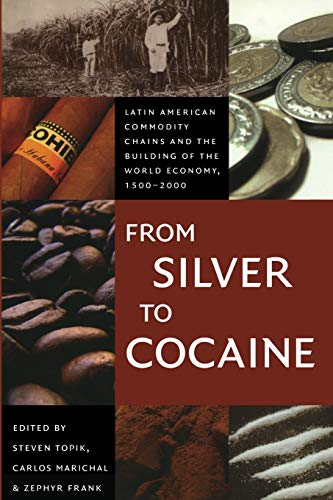
Author(s): Steven Topik, Zephyr Frank, Carlos Marichal
Publication date: 2006-07-18
ISBN: 0822337665, ISBN-13: 9780822337669
By focusing on changing patterns of production and consumption over time, the contributors reconstruct complex webs of relationships and economic processes, highlighting Latin America’s central and interactive place in the world economy. They show how changes in coffee consumption habits, clothing fashions, drug usage, or tire technologies in Europe, Asia, and the Americas reverberate through Latin American commodity chains in profound ways. The social and economic outcomes of the continent’s export experience have been mixed. By analyzing the dynamics of a wide range of commodities over a five-hundred-year period, From Silver to Cocaine highlights this diversity at the same time that it provides a basis for comparison and points to new ways of doing global history.
Contributors. Marcelo Bucheli, Horacio Crespo, Zephyr Frank, Paul Gootenberg, Robert Greenhill, Mary Ann Mahony, Carlos Marichal, David McCreery, Rory Miller, Aldo Musacchio, Laura Nater, Ian Read, Mario Samper, Steven Topik, Allen Wells
The Global Coffee Economy in Africa, Asia, and Latin America, 1500-1989
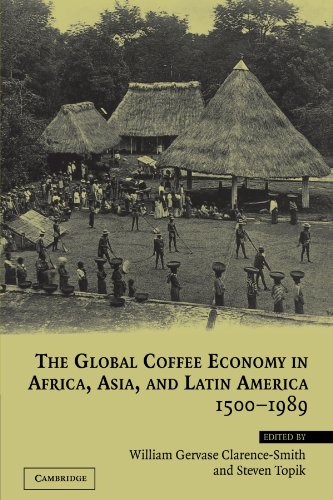
Author(s): William Gervase Clarence-Smith, Steven Topik
Publication date: 2006-02-13
ISBN: 0521521726, ISBN-13: 9780521521727
Trade and Gunboats: The United States and Brazil in the Age of Empire

Author(s): Steven Topik
Publication date: 2000-02-01
ISBN: 0804740186, ISBN-13: 9780804740180
The book begins by examining the Blaine-Mendonca Accord of 1891, the first commercial pact ever signed between Brazil and the United States, thus beginning a special relationship that lasted into the 1970’s. This is the first study of U.S.-Brazilian relations that seriously examines the internal politics and economics of both countries and how they played themselves out in the late nineteenth century. The author attempts a new kind of international history, comparative political economy, that examines not only internal dynamics but also the nature of the international regime at the time.
The Second Conquest of Latin America: Coffee, Henequen, and Oil during the Export Boom, 1850-1930 (Ilas Critical Reflections on Latin America)
Author(s): Steven C. Topik, Allen Wells
Publication date: 1998-01-01
ISBN: 0292781539, ISBN-13: 9780292781535
Between 1850 and 1930, Latin America's integration into the world economy through the export of raw materials transformed the region. This encounter was nearly as dramatic as the conquistadors' epic confrontation with Native American civilizations centuries before. An emphasis on foreign markets and capital replaced protectionism and self-sufficiency as the hemisphere's guiding principles. In many ways, the means employed during this period to tie Latin America more closely to western Europe and North America resemble strategies currently in vogue. Much can be learned from analyzing the first time that Latin Americans embraced export-led growth.
This book focuses on the impact of three key export commodities: coffee, henequen, and petroleum. The authors concentrate on these rather than on national economies because they illustrate more concretely the interaction between the environment, natural and human resources, and the world economy. By analyzing how different products spun complex webs of relationships with their respective markets, the essays in this book illuminate the tensions and contradictions found in the often conflictive relationship between the local and the global, between agency and the not-so-invisible hand. Ultimately, the contributors argue that the results of the "second conquest" were not one-sided as Latin Americans and foreigners together forged a new economic order—one riddled with contradictions that Latin America is still attempting to resolve today.
The World That Trade Created: Society, Culture, And the World Economy, 1400 to the Present
Author(s): Kenneth Pomeranz
Publication date: 0000-00-00
ISBN: 0765623552, ISBN-13: 9780765623553
UC-Irvine : History
- Sharon Block
- Alex Borucki
- Anita Casavantes Bradford
- Vinayak Chaturvedi
- Yong Chen
- Ian Coller
- Touraj Daryaee
- Alice Fahs
- Sarah Farmer
- Qitao Guo
- Douglas Haynes
- Andrew Highsmith
- David Igler
- Adria Imada
- Winston James
- Matthias Lehmann
- Mark LeVine
- Jessica Millward
- Laura J. Mitchell
- Robert G. Moeller
- Susan Morrissey
- Rachel O'Toole
- Allison Perlman
- Kavita Philip
- Ana Elizabeth Rosas
- Vicki Ruiz
- Sharon Salinger
- Patricia Seed
- Heidi Tinsman
- Steven Topik
- Jeffrey Wasserstrom
Most popular books
Link to this page using the following URL: https://www.facultybookshelf.org/author/steven_topik