Books by Rachel O'Toole
Africans to Spanish America: Expanding the Diaspora (New Black Studies Series)
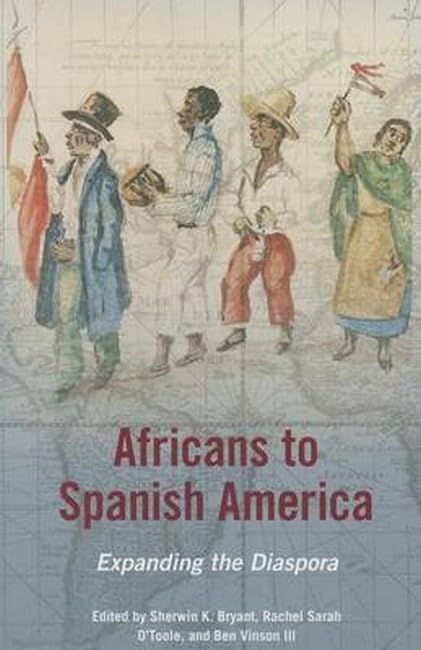
Author(s): Sherwin K. Bryant, Rachel Sarah O'Toole, Ben Vinson
Publication date: 2014-01-08
ISBN: 0252080017, ISBN-13: 9780252080012
Â
Bound Lives: Africans, Indians, and the Making of Race in Colonial Peru (Pitt Latin American Series)

Author(s): Rachel Sarah O'Toole
Publication date: 2012-04-28
ISBN: 0822961938, ISBN-13: 9780822961932
Bound Lives chronicles the lived experience of race relations in northern coastal Peru during the colonial era. Rachel Sarah O’Toole examines the construction of a casta (caste) system under the Spanish government, and how this system was negotiated and employed by Andeans and Africans.
Royal and viceregal authorities defined legal identities of “Indian” and “Black” to separate the two groups and commit each to specific trades and labor. Although they were legally divided, Andeans and Africans freely interacted and depended on each other in their daily lives. Thus, the caste system was defined at both the top and bottom of society. Within each caste, there were myriad subcategories that also determined one’s standing.
The imperial legal system also strictly delineated civil rights. Andeans were afforded greater protections as a “threatened” native population. Despite this, with the crown’s approval during the rise of the sugar trade, Andeans were driven from their communal property and conscripted into a forced labor program. They soon rebelled, migrating away from the plantations to the highlands. Andeans worked as artisans, muleteers, and laborers for hire, and used their legal status as Indians to gain political representation.
As slaves, Africans were subject to the judgments of local authorities, which nearly always sided with the slaveholder. Africans soon articulated a rhetoric of valuation, to protect themselves in disputes with their captors and in slave trading negotiations. To combat the ongoing diaspora from Africa, slaves developed strong kinship ties and offered communal support to the newly arrived.
Bound Lives offers an entirely new perspective on racial identities in colonial Peru. It highlights the tenuous interactions of an imperial power, indigenous group, and enslaved population, and shows how each moved to establish its own power base and modify the existing system to its advantage, while also shaping the nature of colonialism itself.
UC-Irvine : History
- Sharon Block
- Alex Borucki
- Anita Casavantes Bradford
- Vinayak Chaturvedi
- Yong Chen
- Ian Coller
- Touraj Daryaee
- Alice Fahs
- Sarah Farmer
- Qitao Guo
- Douglas Haynes
- Andrew Highsmith
- David Igler
- Adria Imada
- Winston James
- Matthias Lehmann
- Mark LeVine
- Jessica Millward
- Laura J. Mitchell
- Robert G. Moeller
- Susan Morrissey
- Rachel O'Toole
- Allison Perlman
- Kavita Philip
- Ana Elizabeth Rosas
- Vicki Ruiz
- Sharon Salinger
- Patricia Seed
- Heidi Tinsman
- Steven Topik
- Jeffrey Wasserstrom
Most popular books
Link to this page using the following URL: https://www.facultybookshelf.org/author/rachel_otoole