Books by Jacqueline Foertsch

University of North Texas  :   English   :   Jacqueline Foertsch

Reckoning Day: Race, Place, and the Atom Bomb in Postwar America
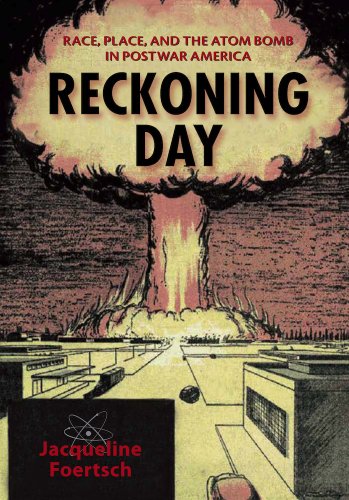
Author(s): Jacqueline Foertsch
Publication date: 2013-09-30
ISBN: 082651927X, ISBN-13: 9780826519276

Too often lost in our understanding of the American Cold War crisis, with its nuclear brinkmanship and global political chess game, is the simultaneous crisis on the nation's racial front. Reckoning Day is the first book to examine the relationship of African Americans to the atom bomb in postwar America. It tells the wide-ranging story of African Americans' response to the atomic threat in the postwar period. It examines the anti-nuclear writing and activism of major figures such as W.E.B. Du Bois, Dr. Martin Luther King Jr., and Lorraine Hansberry as well as the placement (or absence) of black characters in white-authored doomsday fiction and nonfiction. Author Jacqueline Foertsch analyzes the work of African American thinkers, activists, writers, journalists, filmmakers, and musical performers in the "atomic" decades of 1945 to 1965 and beyond. Her book tells the dynamic story of commitment and interdependence, as these major figures spoke with force and eloquence for nuclear disarmament, just as they argued unstintingly for racial equality on numerous other occasions.

Foertsch also examines the location of African American characters in novels, science fiction, and survivalist nonfiction such as government-sponsored forecasts regarding post-nuclear survival. In these, black characters are often displaced or absented entirely: in doomsday narratives they are excluded from executive decision-making and the stories' often triumphant conclusions; in the nonfiction, they are rarely envisioned amongst the "typical American" survivors charged with rebuilding US society. Throughout Reckoning Day, issues of placement and positioning provide the conceptual framework: abandoned at "ground zero" (America's inner cities) during the height of the atomic threat, African Americans were figured in white-authored survival fiction as compliant servants aiding white victory over atomic adversity, while as historical figures they were often perceived as "elsewhere" (indifferent) to the atomic threat. In fact, African Americans' "position" on the bomb was rarely one of silence or indifference. Ranging from appreciation to disdain to vigorous opposition, atomic-era African Americans developed diverse and meaningful positions on the bomb and made essential contributions to a remarkably American dialogue.

Bracing Accounts: The Literature and Culture of Polio in Postwar America
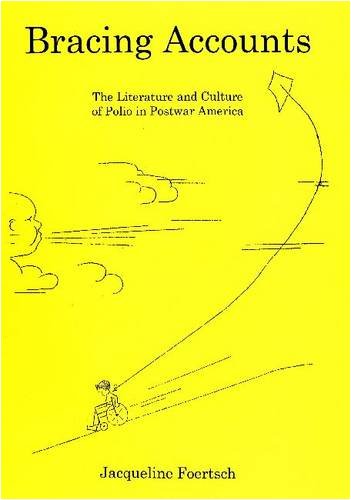
Author(s): Jacqueline Foertsch
Publication date: 2009-01-31
ISBN: 0838641733, ISBN-13: 9780838641736

This book is the textual response to polio from the postwar era to the present. It considers women's magazines, in which polio was both a fitfully treated subject and a frequently important subtext; polio memoirs, which boomed in the postwar period but continue to influence the illness-memoir marketplace today; and, polio novels, the vast majority of which were not published until nearly two decades following the Salk vaccine. The author interprets the gendered and generational aspects of these vital polio texts, as well as themes of denial, depression, ableism, acceptance, illness, impairment, and the American past.In the final chapter she reads a wide array of texts generated by and for the polio-affected community, beginning with newsletters issued by rehabilitation centers such as those at Warm Springs, Ga. (founded by FDR), and continued as internationally circulated special-interest magazines and, more recently, Web sites and discussion venues in which those dealing with post-polio syndrome inform and sustain each other. Complementing the wealth of polio histories that have recently appeared (many in conjunction with the fiftieth anniversary of the Salk vaccine), the literary analysis continues to explore this meaningful context, while focusing specifically on the polio story - its fictions, revelations, and rhetorical strategies - as this has shaped our understanding of a major twentieth-century medical. Jacqueline Foertsch is Professor of English at the University of North Texas.

American Culture in the 1940s (Twentieth Century American Culture EUP)

Author(s): Jacqueline Foertsch
Publication date: 2008-03-27
ISBN: 0748624139, ISBN-13: 9780748624133

This book explores the major cultural forms of 1940s America - fiction and non-fiction; music and radio; film and theatre; serious and popular visual arts - and key texts, trends and figures, from Native Son to Citizen Kane, from Hiroshima to HUAC, and from Dr Seuss to Bob Hope. After discussing the dominant ideas that inform the 1940s the book culminates with a chapter on the 'culture of war'. Rather than splitting the decade at 1945, Jacqueline Foertsch argues persuasively that the 1940s should be taken as a whole, seeking out links between wartime and postwar American culture.

Conflict and Counterpoint in Lesbian, Gay, and Feminist Studies

Author(s): Jacqueline Foertsch
Publication date: 2007-04-15
ISBN: 1403978999, ISBN-13: 9781403978998

Interrogating a broad array of lesbian, gay, and feminist theories, this book considers instances of unnecessarily divisive turf-battling, yet focuses primarily on the productive debates that define and vitalize the field. Moving beyond the classic opposition that pits the sex-positive leftist academy against abstract "sexism" and "homophobia," Foertsch's text isolates oppositions within gender and sexuality studies, considering homophobic feminist theories, sexist (or anti-feminist) gay theories, and the field's tendency to triangulate itself in two-against-one fashion or in contests between two camps for the allegiance of the third.

Enemies Within: The Cold War and the AIDS Crisis in Literature, Film, and Culture
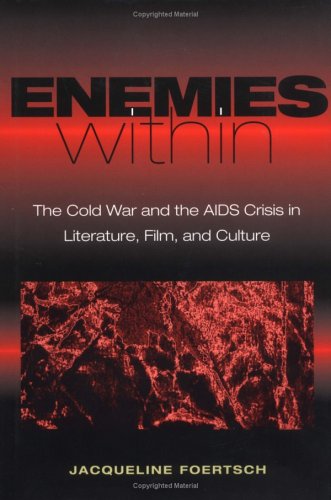
Author(s): Jacqueline Foertsch
Publication date: 2001-05-17
ISBN: 0252026373, ISBN-13: 9780252026379

"Enemies Within" traces the discourse of hostility, hysteria, and global threat that links the literature and film of the cold war era with that of the AIDS era. Not only the political and biological illnesses themselves but also the fear and panic they engender are the plagues with which Jacqueline Foertsch is concerned in this wide-ranging study. "Enemies Within" argues that our shared experience of and response to AIDS not only significantly resembles but also emerged directly from its mid-century predecessor, which conditioned us to dread worldwide biological disaster and an invisible enemy.Foertsch considers the 'false binaries' (straight/gay, patriot/traitor, healthy/infected) that promise protection from an invasive threat and the utopian impulse to purge, homogenize, and relocate problematic individuals outside the city walls. Tracking the coded language of illness and cure, Foertsch unravels the plague imagery of such texts as George Orwell's "1984", Thomas Pynchon's "Gravity's Rainbow", Margaret Atwood's "Handmaid's Tale", Ray Bradbury's "Fahrenheit 451", Paul Auster's "In the Country of Last Things", Don DeLillo's "White Noise", and Armistad Maupin's "Tales of the City" series.She also compares cold war-era films with their AIDS-era remakes, showing that although the enemy threat changes shape, the plague of human hysteria remains remarkably constant. Forthright and perceptive, "Enemies Within" presents the literature and film of the cold war and AIDS eras as evidence, manifestation, and symptom of the recurring ills of our postnuclear time: global threat, buried fears, and a paranoid reaction to the infectious Other.

Link to this page using the following URL:  https://www.facultybookshelf.org/author/jacqueline_foertsch

FacultyBookshelf.org is a participant in the Amazon Services LLC Associates Program and earns money on qualifying purchases.