Books by Robert Citino
Why Germany Nearly Won: A New History of the Second World War in Europe

Author(s): Steven D. Mercatante
Publication date: 2014-07-10
ISBN: 1442236868, ISBN-13: 9781442236868
Why Germany Nearly Won: A New History of the Second World War in Europe challenges this conventional wisdom, highlighting how the re-establishment of the traditional German art of war—updated to accommodate new weapons systems—paved the way for Germany to forge a considerable military edge over its much larger rivals by playing to its qualitative strengths as a continental power. Ironically, these methodologies also created and exacerbated internal contradictions that undermined the very war machine they enabled and left it vulnerable to enemies with the capacity to adapt and build on potent military traditions of their own.
The book begins by examining the methods by which the German economy and military prepared for war and the military establishment's formidable strengths—plus weaknesses. Steven D. Mercatante then offers an entirely new perspective on the Second World War in Europe. He demonstrates how Germany, through its invasion of the Soviet Union, came within a hairsbreadth of cementing a European-based empire that would have allowed the Third Reich to challenge the Anglo-American alliance for global hegemony. This outcome, according to commonly cited measures of military potential, should have been completely out of Germany's reach. The author concludes by tracing the final years of the war and assessing how Germany was able to hang on far longer than expected against the world's most powerful nations working in concert to engineer its defeat.
The Wehrmacht Retreats: Fighting a Lost War, 1943 (Modern War Studies)

Author(s): Robert M. Citino
Publication date: 2012-03-01
ISBN: 0700618260, ISBN-13: 9780700618262
Drawing on his impeccable command of German-language sources, Citino offers fresh, vivid, and detailed treatments of key campaigns during this fateful year: the Allied landings in North Africa, General von Manstein's great counterstroke in front of Kharkov, the German attack at Kasserine Pass, the titanic engagement of tanks and men at Kursk, the Soviet counteroffensives at Orel and Belgorod, and the Allied landings in Sicily and Italy. Through these events, he reveals how a military establishment historically configured for violent aggression reacted when the tables were turned; how German commanders viewed their newest enemy, the U.S. Army, after brutal fighting against the British and Soviets; and why, despite their superiority in materiel and manpower, the Allies were unable to turn 1943 into a much more decisive year.
Applying the keen operational analysis for which he is so highly regarded, Citino contends that virtually every flawed German decision—to defend Tunis, to attack at Kursk and then call off the offensive, to abandon Sicily, to defend Italy high up the boot and then down much closer to the toe—had strong supporters among the army's officer corps. He looks at all of these engagements from the perspective of each combatant nation and also establishes beyond a shadow of a doubt the synergistic interplay between the fronts.
Ultimately, Citino produces a grim portrait of the German officer corps, dispelling the longstanding tendency to blame every bad decision on Hitler. Filled with telling vignettes and sharp portraits and copiously documented, The Wehrmacht Retreats is a dramatic and fast-paced narrative that will engage military historians and general readers alike.
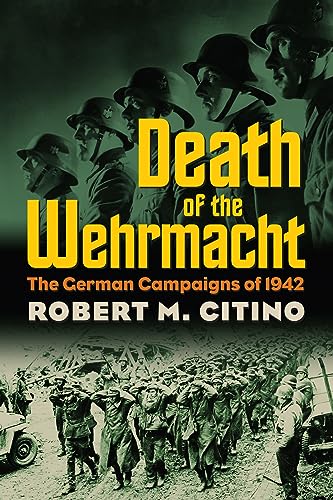
Death of the Wehrmacht: The German Campaigns of 1942 (Modern War Studies (Paperback))
Author(s): Robert M. Citino
Publication date: 2007-10-22
ISBN: 0700617914, ISBN-13: 9780700617913
From the overwhelming operational victories at Kerch and Kharkov in May to the catastrophic defeats at El Alamein and Stalingrad, Death of the Wehrmacht offers an eye-opening new view of that decisive year. Building upon his widely respected critique in The German Way of War, Citino shows how the campaigns of 1942 fit within the centuries-old patterns of Prussian/German warmaking and ultimately doomed Hitler's expansionist ambitions. He examines every major campaign and battle in the Russian and North African theaters throughout the year to assess how a military geared to quick and decisive victories coped when the tide turned against it.
Citino also reconstructs the German generals' view of the war and illuminates the multiple contingencies that might have produced more favorable results. In addition, he cites the fatal extreme aggressiveness of German commanders like Erwin Rommel and assesses how the German system of command and its commitment to the "independence of subordinate commanders" suffered under the thumb of Hitler and chief of staff General Franz Halder.
More than the turning point of a war, 1942 marked the death of a very old and traditional pattern of warmaking, with the classic "German way of war" unable to meet the challenges of the twentieth century. Blending masterly research with a gripping narrative, Citino's remarkable work provides a fresh and revealing look at how one of history's most powerful armies began to founder in its quest for world domination.
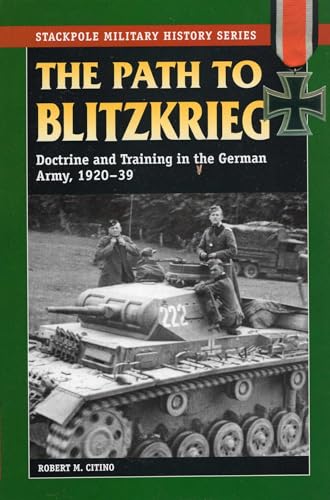
Path to Blitzkrieg: Doctrine and Training in the German Army, 1920-39 (Stackpole Military History Series)
Author(s): Robert M. Citino
Publication date: 2007-12-26
ISBN: 0811734579, ISBN-13: 9780811734578
In the wake of World War I, the German army lay in ruins--defeated in the war, sundered by domestic upheaval, and punished by the Treaty of Versailles. A mere twenty years later, Germany possessed one of the finest military machines in the world, capable of launching a stunning blitzkrieg attack against Poland in 1939. Well-known military historian Robert M. Citino shows how Germany accomplished this astonishing reversal and developed the doctrine, tactics, and technologies that its military would use to devastating effect in World War II.
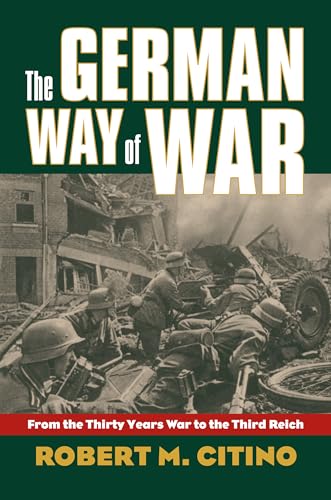
The German Way of War: From the Thirty Years' War to the Third Reich (Modern War Studies (Paperback))
Author(s): Robert M. Citino
Publication date: 2005-11-17
ISBN: 0700616241, ISBN-13: 9780700616244
Citino focuses on operational warfare to demonstrate continuity in German military campaigns from the time of Elector Frederick Wilhelm and his great "sleigh-drive" against the Swedes to the age of Adolf Hitler and the blitzkrieg to the gates of Moscow. Along the way, he underscores the role played by the Prussian army in elevating a small, vulnerable state to the ranks of the European powers, describes how nineteenth-century victories over Austria and France made the German army the most respected in Europe, and reviews the lessons learned from the trenches of World War I.
Through this long view, Citino reveals an essential recurrent pattern—characterized by rapid troop movements and surprise attacks, maneuvers to outflank the enemy, and a determination to annihilate the opposition—that made it possible for the Germans to fight armies often larger than their own. He highlights the aggressiveness of Prussian and German commanders—trained simply to find the enemy and keep attacking—and destroys the myth of Auftragstaktik ("flexible command"), replacing it with the independence of subordinate commanders. He also brings new interpretations to well-known operations, such as Moltke's 1866 campaign and the opening campaign in 1914, while introducing readers to less familiar but important battles like Langensalza and the Annaberg.
The German way of war, as Citino shows, was fostered by the development of a widely accepted and deeply embedded military culture that supported and rewarded aggression. His book offers a fresh look at one of the most remarkable, respected, and reviled militaries of the past half millennium and marks another sterling contribution to the history of operational warfare.
Blitzkrieg to Desert Storm: The Evolution of Operational Warfare

Author(s): Robert M. Citino
Publication date: 2004-04-25
ISBN: 0700613005, ISBN-13: 9780700613007
Robert Citino analyzes military campaigns from the second half of the twentieth century to further demonstrate the difficulty of achieving decisive results at the operational level. Offering detailed operational analyses of actual campaigns, Citino describes how UN forces in Korea enjoyed technological and air superiority but found the enemy unbeatable; provides analyses of Israeli operational victories in successive wars until the Arab states finally grasped the realities of operational-level warfare in 1973; and tells how the Vietnam debacle continued to shape U.S. doctrine in surprising ways. Looking beyond major-power conflicts, he also reveals the lessons of India's blitzkrieg-like drive into Pakistan in 1971 and of the senseless bloodletting of the Iran-Iraq War.
Citino especially considers the evolution of U.S. doctrine and assesses the success of Desert Storm in dismantling an entrenched defending force with virtually no friendly casualties. He also provides one of the first scholarly analyses of Operation Iraqi Freedom, showing that its plan was curiously divorced from the realities of military history, grounded instead on nebulous theories about expected enemy behavior. Throughout Citino points to the importance of mobility—especially mobilized armor—in modern operational warfare and assesses the respective roles of firepower, training, doctrine, and command and control mechanisms.
Brimming with new insights, Citino's study shows why technical superiority is no guarantee of victory and why a thorough grounding in the history of past campaigns is essential to anyone who wishes to understand modern warfare. Blitzkrieg to Desert Storm provides that grounding as it addresses the future of operational-level warfare in the post-9/11 era.
Quest for Decisive Victory: From Stalemate to Blitzkrieg in Europe, 1899-1940 (Modern War Studies (Paperback))

Author(s): Robert M. Citino
Publication date: 2002-06-17
ISBN: 0700616551, ISBN-13: 9780700616558
Robert Citino now tells how European military leaders analyzed and eventually overcame this problem by restoring pursuit to its rightful place in combat and resurrecting the possibility of decisive warfare on the operational level.
Quest for Decisive Victory chronicles the evolution of European warfare during the first half of the twentieth century. A study of war at the operational level, it demonstrates the interplay and tension between technology and doctrine in warfare and reveals how problems surrounding mobility—including such factors as supply lines, command and control, and prewar campaign planning—forced armies to find new ways of fighting.
Citino focuses on key campaigns of both major and minor conflicts. Minor wars before 1914 (Boer, Russo-Japanese, and the Balkan Wars of 1912-13) featured instructive examples of operational maneuver; the First World War witnessed the collapse of operations and the rise of attrition warfare; the Italo-Ethiopian and Spanish Civil Wars held some promise for breaking out of stalemate by incorporating such innovations as air and tank warfare. Ultimately, it was Germany's opening blitzkrieg of World War II that resurrected the decisive campaign as an operational possibility. By grafting new technologies—tanks, aircraft, and radio—onto a long tradition of maneuver warfare, the Wehrmacht won decisive victories in the first year of the war and in the process transformed modern military doctrine.
Citino's study is important for shifting the focus from military theory and doctrine to detailed operational analyses of actual campaigns that formed the basis for the revival of military doctrine. Quest for Decisive Victory gives scholars of military history a better grasp of that elusive concept and a more complete understanding of modern warfare.
Armored Forces: History and Sourcebook (Histories and Sourcebooks on Combat Forces)

Author(s): Robert M. Citino
Publication date: 1994-10-21
ISBN: 0313285004, ISBN-13: 9780313285004
This volume analyzes the development of tanks and traces their history from the British attack at Cambrai in 1917 during World War I through the AirLand Battle of Operation Desert Storm in 1991. This text gives a short history of the rise and development of armored warfare in the 20th century, an assessment of the significant literature on tank doctrine, and an evaluation of the role of prominent commanders, theoreticians, and tacticians. A chronology of important dates and pictures depicting major changes in tanks across the years enrich this teaching tool and reference guide for teachers and students of military history, history buffs, and professional soldiers.
Germany and the Union of South Africa in the Nazi Period: (Contributions to the Study of World History)

Author(s): Robert M. Citino
Publication date: 1991-04-30
ISBN: 0313277893, ISBN-13: 9780313277894
This is the first study to examine Nazi German foreign policy towards the Union of South Africa from 1933-1939. Making extensive use of unpublished primary source German documents, Robert Citino focuses on the activities of the German embassy and consulates within South Africa in order to answer four basic questions: What role did race and racial theory play in German foreign policy towards South Africa? Did Germany attempt to exploit South African yearnings for international respect, and, if so, how? Did the Germans seek to take advantage of deep divisions within South African society between British and Afrikaners? Finally, to what extent was the German Foreign Office Nazified in the 1930s? By concentrating on the policies and views of German diplomatic personnel within a single country--rather than on Hitler's grandiose proclamations and speeches on world affairs--Citino offers a closer look at Nazi German foreign policy operations than is usually available.
The study is organized chronologically and begins with an overview of German-South African relations before 1933. Subsequent chapters address early tensions and South African domestic developments in the years leading up to the outbreak of war. Specific topics covered include the role played by the former German colony of Southwest Africa in relations between the two states, the hostile attitude of much of the South African press towards Nazi Germany, the boycott of German firms by the South African Jewish community, the Smuts-Hertzog fusion, the rise of Malan and his Purified nationalist party, the growth of anti-Semitism in South Africa and the concurrent growth in Afrikaner national consciousness, and South African attitudes towards the major European crises of the 1930s. Citino concludes by analyzing Germany's inability to keep South Africa neutral in 1939 and the entry of the Union into the war at England's side. Students of modern German, South African, and twentieth century diplomatic history will find Citino's work an enlightening contribution to the literature of Nazi Germany's foreign relations.
The Evolution of Blitzkrieg Tactics: Germany Defends Itself Against Poland, 1918-1933 (Contributions in Military Studies)
Author(s): Robert M. Citino
Publication date: 1987-06-04
ISBN: 0313256314, ISBN-13: 9780313256318
This study provides a tactical, strategic, and operational view of the interwar German army as a fighting organization. The book describes in detail the process by which the Reichswehr attempted the accomplishment of its principal task--that of defending Germany's borders, particularly those along the eastern frontier, from the end of the First World War until the formation of the Hitler cabinet in January 1933.
University of North Texas : History
- Roberto Calderon
- Randolph Campbell
- Guy Chet
- Robert Citino
- Christopher Fuhrmann
- Richard Golden
- Constance Hilliard
- Michael Leggiere
- Richard Lowe
- Richard McCaslin
- Alex Mendoza
- Alfred Mierzejewski
- Marilyn Morris
- J. Todd Moye
- Clark Pomerleau
- Gustav Seligmann
- F. Todd Smith
- Harold Tanner
- Andrew Torget
- Elizabeth Hayes Turner
- Olga Velikanova
- Geoffrey Wawro
- Michael Wise
Most popular books
Link to this page using the following URL: https://www.facultybookshelf.org/author/robert_citino