Books by F. Todd Smith
Colonial Natchitoches: A Creole Community on the Louisiana-Texas Frontier (Elma Dill Russell Spencer Series in the West and Southwest)
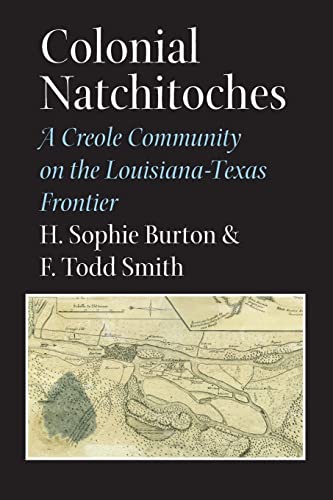
Author(s): Helen Sophie Burton, F. Todd Smith
Publication date: 2014-11-07
ISBN: 1623492068, ISBN-13: 9781623492069
Strategically located at the western edge of the Atlantic World, the French post of Natchitoches thrived during the eighteenth century as a trade hub between the well-supplied settlers and the isolated Spaniards and Indians of Texas. Its critical economic and diplomatic role made it the most important community on the Louisiana-Texas frontier during the colonial era.
Despite the community’s critical role under French and then Spanish rule, Colonial Natchitoches is the first thorough study of its society and economy. Founded in 1714, four years before New Orleans, Natchitoches developed a creole (American-born of French descent) society that dominated the Louisiana-Texas frontier.
H. Sophie Burton and F. Todd Smith carefully demonstrate not only the persistence of this creole dominance but also how it was maintained. They examine, as well, the other ethnic cultures present in the town and relations with Indians in the surrounding area.
Through statistical analyses of birth and baptismal records, census figures, and appropriate French and Spanish archives, Burton and Smith reach surprising conclusions about the nature of society and commerce in colonial Natchitoches.
Despite the community’s critical role under French and then Spanish rule, Colonial Natchitoches is the first thorough study of its society and economy. Founded in 1714, four years before New Orleans, Natchitoches developed a creole (American-born of French descent) society that dominated the Louisiana-Texas frontier.
H. Sophie Burton and F. Todd Smith carefully demonstrate not only the persistence of this creole dominance but also how it was maintained. They examine, as well, the other ethnic cultures present in the town and relations with Indians in the surrounding area.
Through statistical analyses of birth and baptismal records, census figures, and appropriate French and Spanish archives, Burton and Smith reach surprising conclusions about the nature of society and commerce in colonial Natchitoches.
From Dominance to Disappearance: The Indians of Texas and the Near Southwest, 1786-1859
Author(s): F. Todd Smith
Publication date: 2008-12-01
ISBN: 0803220774, ISBN-13: 9780803220775
From Dominance to Disappearance is the first detailed history of the Indians of Texas and the Near Southwest from the late eighteenth to the middle nineteenth century, a period that began with Native peoples dominating the region and ended with their disappearance, after settlers forced the Indians in Texas to take refuge in Indian Territory.
Â
Drawing on a variety of published and unpublished sources in Spanish, French, and English, F. Todd Smith traces the differing histories of Texas’s Native peoples. He begins in 1786, when the Spaniards concluded treaties with the Comanches and the Wichitas, among others, and traces the relations between the Native peoples and the various Euroamerican groups in Texas and the Near Southwest, an area encompassing parts of Texas, Louisiana, Arkansas, and Oklahoma. For the first half of this period, the Native peoples—including the Caddos, the Karankawas, the Tonkawas, the Lipan Apaches, and the Atakapas as well as emigrant groups such as the Cherokees and the Alabama-Coushattas—maintained a numerical superiority over the Euroamericans that allowed them to influence the region’s economic, military, and diplomatic affairs. After Texas declared its independence, however, the power of Native peoples in Texas declined dramatically, and along with it, their ability to survive in the face of overwhelming hostility. From Dominance to Disappearance illuminates a poorly understood chapter in the history of Texas and its indigenous people.
The Wichita Indians: Traders of Texas and the Southern Plains, 1540-1845 (Centennial Series of the Association of Former Students, Texas A&M University)
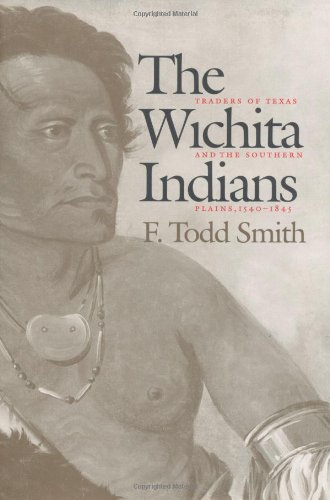
Author(s): F. Todd Smith
Publication date: 2000-07-01
ISBN: 0890969523, ISBN-13: 9780890969526
When two Wichita traders first encountered Europeans visiting the Pecos Pueblo in 1540, the Wichita tribes dominated the Southern Plains area, which stretched from Kansas to Central Texas. In the three centuries that followed, the Wichitas would be forced to negotiate with competitors, both European and Indian, for land, resources, trade, and their very survival. The Wichita Indians presents a thorough narrative of these bands from their first contact with Europeans until 1845, when the United States annexed Texas. Historian F. Todd Smith provides background information on the Wichita Indians' provenance—the separate tribes of Taovayas, Tawakonis, Kichais, Wacos, and other bands whose shared language and culture united them for survival when external pressures increased. Offering detailed descriptions of their battles, negotiations, trading practices, and survival strategies, Smith traces the Wichitas' struggles to adapt to rapidly changing circumstances and defend themselves from encroaching tribes and white settlers. A companion to Smith's other works on the early Caddos and the post-1845 Wichita and Caddo peoples, The Wichita Indians fills a gap in the history of Native Americans by focusing on this important tribe whose influence peaked on the Southern Plains long before the United States came into being.
The Caddo Indians: Tribes at the Convergence of Empires, 1542-1854 (Centennial Series of the Association of Former Students, Texas A&M University)
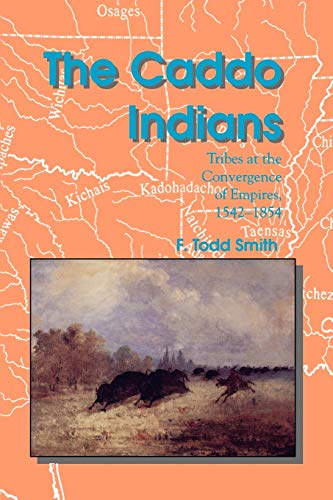
Author(s): F. Todd Smith
Publication date: 2000-06-01
ISBN: 0890969817, ISBN-13: 9780890969816
In 1542 members of the thriving Caddo Indian culture came face to face with Luis de Moscoso, successor to Hernando de Soto as leader of a Spanish exploration party. That encounter marked a turning point for this centuries-old people, whose history from then on would be dominated by the interaction of the native confederacies with the empires of various European adventurers and settlers.Much has been written about the confrontations of Euro-Americans with Native Americans, but most of it has focused on the Anglo-Indian relations of the eastern part of the continent or on the final phases of the western wars. This thorough and engaging history is the first to focus intensively on the Caddos of the Texas-Louisiana border area. Primarily from the perspective of the Caddos themselves, it traces the development and effect of relations over the three hundred years from the first meeting with the Spaniards until the resettlement of the tribes on the Brazos Reserve in 1854.In an impressive work of scholarship and lucid writing, F. Todd Smith chronicles all three of the Caddo confederacies–Kadohadacho, Hasinai, and Natchitoches–as they consolidated into a single tribe to face the waves of soldiers, traders, and settlers from the empires of Spain, France, the United States, Mexico, and the Republic of Texas. It describes the delicate balance the Caddos struck with the various nations claiming the region and how that gradually evolved into a less beneficial relationship. Caught in the squeeze between Euro-American nations, the Caddos eventually sacrificed their independence and much of their culture to gain the benefits offered by the invaders. Falling victim to swindlers, they at last lost their lands and were moved to a reservation. This intriguing new view of a little-known aspect of history will fascinate those interested in the culture and fate of American Indians. Thorough in its research and comprehensive in scope, it offers valuable insight into the differing approaches of the various European and American nations to the native peoples and a compelling understanding of the futility of the efforts of even some of the most sophisticated tribes in coping successfully with the changes wrought.
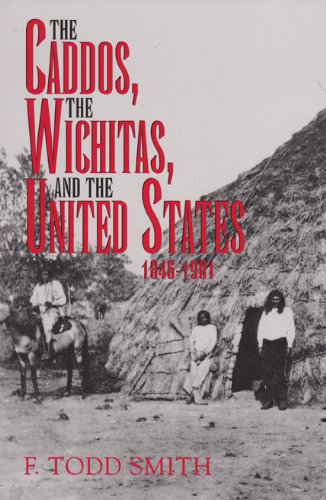
The Caddos, the Wichitas, and the United States, 1846-1901 (Centennial Series of the Association of Former Students, Texas A&M University)
Author(s): F. Todd Smith
Publication date: 1996-11-01
ISBN: 0890967083, ISBN-13: 9780890967089
Although the Wichita Indians, of Caddoan stock, had separated from the Caddos proper about 1500 B.C., the two peoples maintained close ties. In 1846, when the various Indian tribes of Texas signed a far-reaching treaty with the United States, the Wichitas and Caddos both also had a history of relations with the Euroamericans. Both tribes had become in many ways dependent on the Europeans--for firearms, clothing, tools, and cosmetic goods. This dependence, which had served them well during the years of European exploration and colonization, had by 1846 made them vulnerable to the demands of the young American nation for more and more land for settlement. Both tribes--the Wichitas voluntarily, the Caddos under duress--headed west.F. Todd Smith's new narrative picks up the story of these tribes begun in his volume The Caddo Indians: Tribes at the Convergence of Empires, 1542-1854. Their relations with the United States government, the state of Texas (whose role in Indian policy was distinctive because of its previous status as a sovereign nation), and officials of Indian Territory, as well as their ongoing struggles with other tribes similarly being forced from traditional lands, make compelling reading. Smith documents the process by which the Caddos and Wichitas increasingly lost control of their own fate and came to be governed by the whim of the federal government. Smith relates the political history of the two tribes, details life and agricultural work on the reservation, chronicles federal attempts to introduce an education system to the Indians, and traces the effect of hostile tribes and unscrupulous whites on the reservation experiment. Using primary documents, he traces the history of the Wichitas and Caddos through the Civil War, when they were forced to take refuge in Union-controlled Kansas, to the sharing of reservation land with their former enemies, the Kiowas and Comanches. He describes in details the efforts of the two tribes to adapt to white ways, developing a life within the confines of the reservation experience that borrowed from Euroamerican culture while retaining many of their own traditions. Finally, he shows how, even as the Wichitas and Caddos adapted to Euroamerican culture successfully, the federal government changed its policies again, this time attacking the very concept of tribalism and breaking up the reservation system.Throughout the book, Smith convincingly analyzes how the successful adaptation of the tribes to white demands itself undermined their power and future. In the end, Smith shows, the Caddos and Wichitas used the Euroamerican legal system to fight the last battle--unsuccessfully--losing the very basis of tribal life, shared land.
University of North Texas : History
- Roberto Calderon
- Randolph Campbell
- Guy Chet
- Robert Citino
- Christopher Fuhrmann
- Richard Golden
- Constance Hilliard
- Michael Leggiere
- Richard Lowe
- Richard McCaslin
- Alex Mendoza
- Alfred Mierzejewski
- Marilyn Morris
- J. Todd Moye
- Clark Pomerleau
- Gustav Seligmann
- F. Todd Smith
- Harold Tanner
- Andrew Torget
- Elizabeth Hayes Turner
- Olga Velikanova
- Geoffrey Wawro
- Michael Wise
Most popular books
Link to this page using the following URL: https://www.facultybookshelf.org/author/f_todd_smith